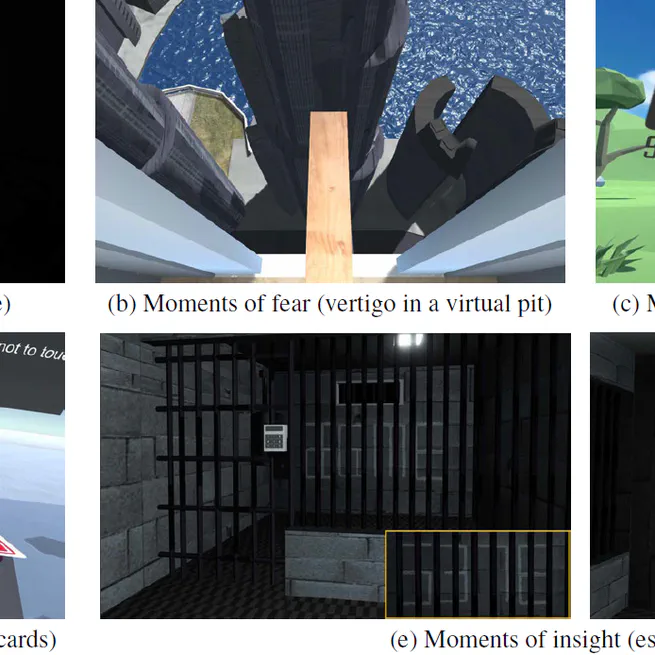
Characterizing Physiological Responses to Fear, Frustration, and Insight in Virtual Reality
Physiological sensing often complements studies of human behavior in virtual reality (VR) to detect users’ affective and cognitive states. Some psychological states, such as fear and frustration, can be particularly hard to differentiate from a physiological perspective as they are close in the arousal and valence emotional space. Moreover, it is largely unclear how users’ physiological reactions are expressed in response to transient psychological states such as fear, frustration, and insight—especially since these are rich indicators for characterizing users’ responses to dynamic systems but are hard to capture in highly interactive settings. We conducted a study (N=24) to analyze participants’ pulmonary, electrodermal, cardiac, and pupillary responses to moments of fear, frustration, and insight in immersive settings. Participants interacted in five VR environments, throughout which we measured their physiological reactions and analyzed the patterns. We also measured subjective fear and frustration using questionnaires.
Oct 24, 2022
Pyramid Escape: Design of Novel Passive Haptics Interactions for an Immersive and Modular Scenario
In this paper, we present the design of ten different 3D user interactions using passive haptics and embedded in an escape game scenario in which users have to escape from a pyramid in a limited time. Our solution is innovative by its modularity, allowing interactions with virtual objects using tangible props manipulated either directly using the hands and feet or indirectly through a single prop held in the hand, in order to perform several interactions with the virtual environment. We also propose a navigation technique based on the “impossible spaces” design, allowing users to naturally walk through several overlapping rooms of the VE.
Mar 6, 2019
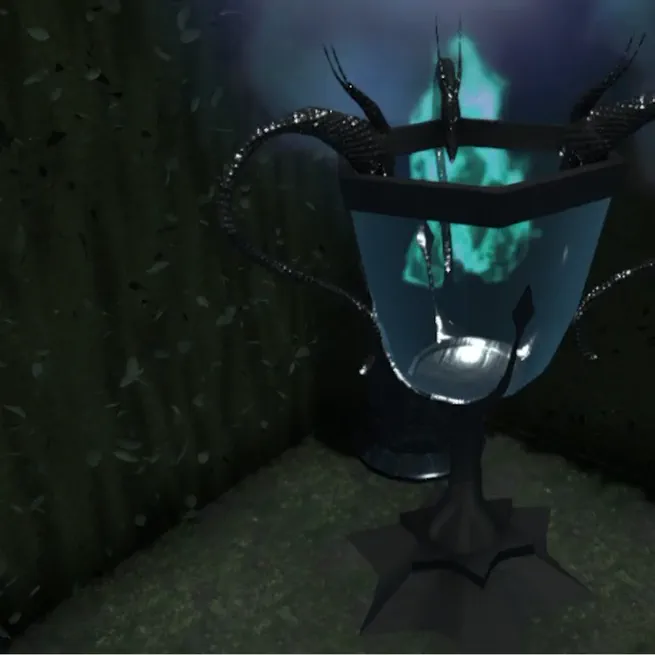
The Labyrinth of Harry Potter and the Goblet of Fire
An interactive VR app featuring impossible spaces navigation
May 5, 2017
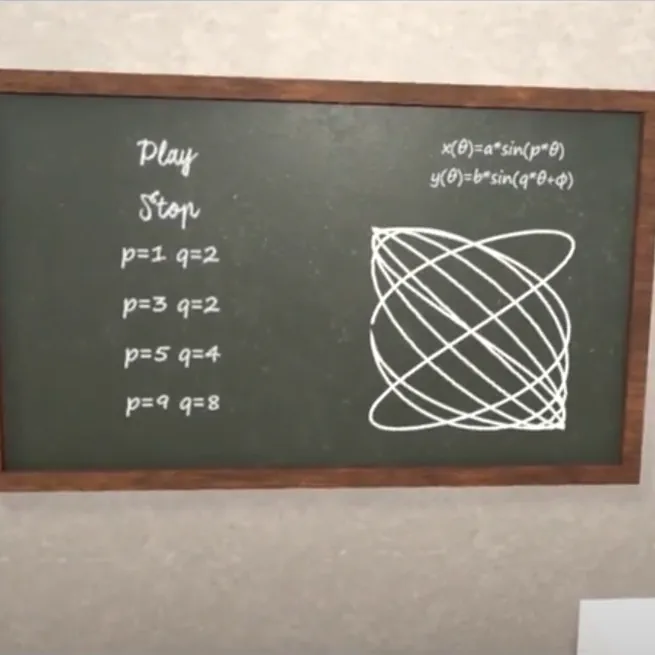
Drop the Base
A collaborative VR app to learn fundamental physics equations through an immersive escape room
Feb 5, 2017