InfinitePaint: Painting in Virtual Reality with Passive Haptics Using Wet Brushes and a Physical Proxy Canvas
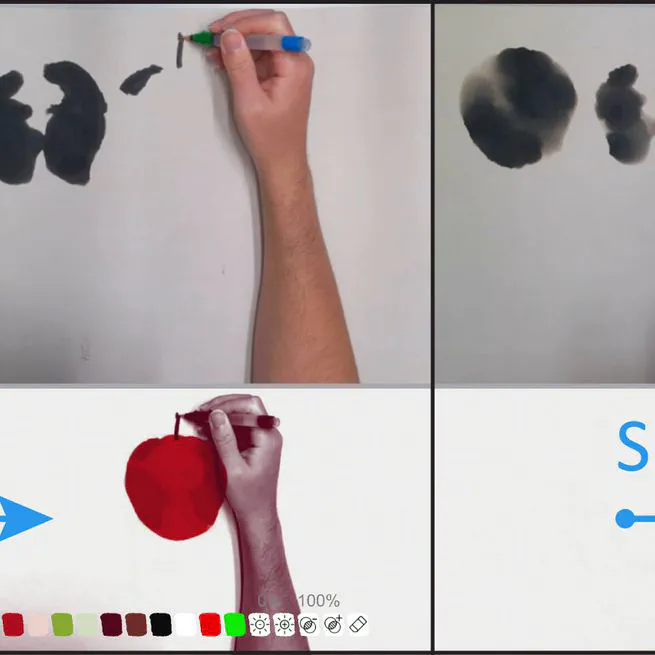
InfinitePaint is a system that supports digital painting in Virtual Reality on real paper with a real wet brush. We use special paper that turns black wherever it comes into contact with water and turns blank again upon drying. A single camera captures those temporary strokes and digitizes them while applying properties like color or other digital effects. We tested our system with artists and compared the subjective experience with a drawing tablet.
Apr 26, 2023
ComforTable User Interfaces: Surfaces Reduce Input Error, Time, and Exertion for Tabletop and Mid-air User Interfaces
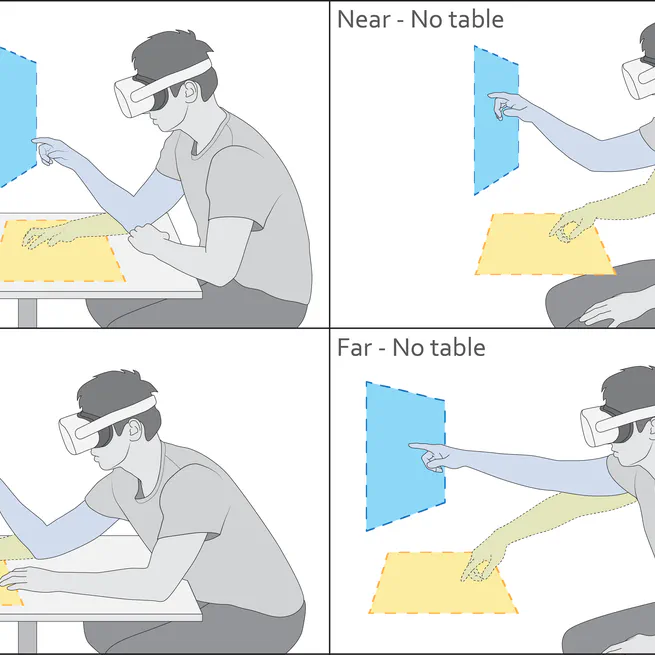
Real-world work-spaces typically revolve around tables, which enable knowledge workers to comfortably perform tasks over an extended period of time during productivity tasks. Tables afford more ergonomic postures and provide opportunities for rest, which raises the question of whether they may also benefit prolonged interaction in Virtual Reality (VR). In this paper, we investigate the effects of tabletop surface presence in situated VR settings on task performance, behavior, and subjective experience. In an empirical study, 24 participants performed two tasks (selection, docking) on virtual interfaces placed at two distances and two orientations.
Oct 17, 2022
Pyramid Escape: Design of Novel Passive Haptics Interactions for an Immersive and Modular Scenario
In this paper, we present the design of ten different 3D user interactions using passive haptics and embedded in an escape game scenario in which users have to escape from a pyramid in a limited time. Our solution is innovative by its modularity, allowing interactions with virtual objects using tangible props manipulated either directly using the hands and feet or indirectly through a single prop held in the hand, in order to perform several interactions with the virtual environment. We also propose a navigation technique based on the “impossible spaces” design, allowing users to naturally walk through several overlapping rooms of the VE.
Mar 6, 2019