ComforTable User Interfaces: Surfaces Reduce Input Error, Time, and Exertion for Tabletop and Mid-air User Interfaces
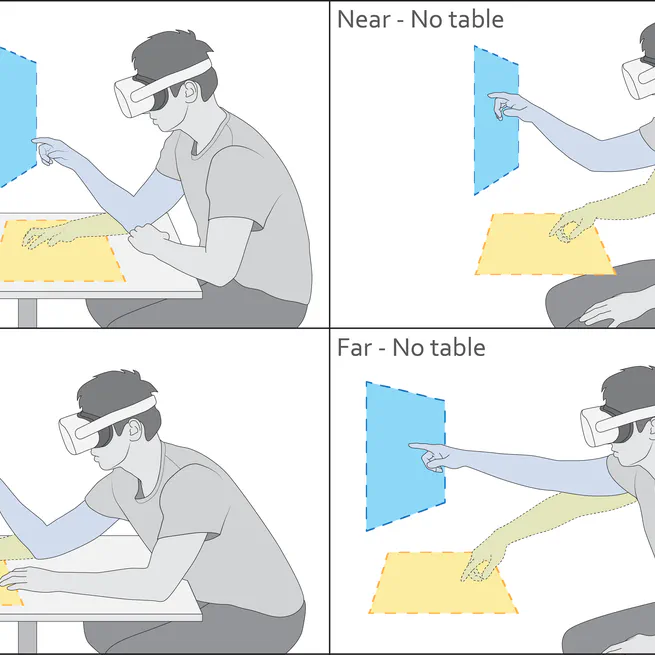
Real-world work-spaces typically revolve around tables, which enable knowledge workers to comfortably perform tasks over an extended period of time during productivity tasks. Tables afford more ergonomic postures and provide opportunities for rest, which raises the question of whether they may also benefit prolonged interaction in Virtual Reality (VR). In this paper, we investigate the effects of tabletop surface presence in situated VR settings on task performance, behavior, and subjective experience. In an empirical study, 24 participants performed two tasks (selection, docking) on virtual interfaces placed at two distances and two orientations.
Oct 17, 2022
Towards Real-Time Recognition of Users’ Mental Workload Using Integrated Physiological Sensors Into a VR HMD
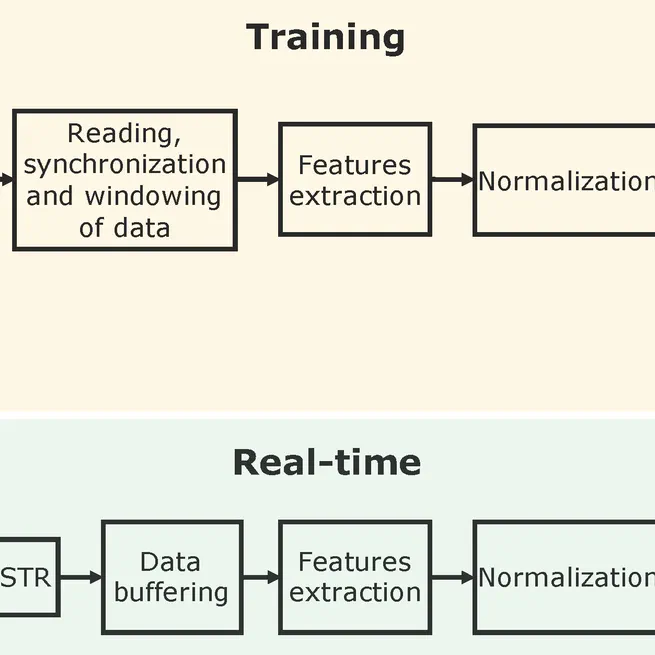
This paper describes an ``all-in-one'' solution for the real-time recognition of users' mental workloads in VR through the customization of a commercial HMD with physiological sensors. We conducted an extensive user study (N = 75) to collect mental workload data. The classification accuracy of 4 levels of mental workload using sensors embedded in the HMD is compared to the classification performance using commercial grade systems. In addition, we discuss the role of the signal normalization procedures and the contribution of the different physiological signals on the recognition accuracy.
Nov 6, 2020
Introducing Mental Workload Assessment for the Design of Virtual Reality Training Scenarios
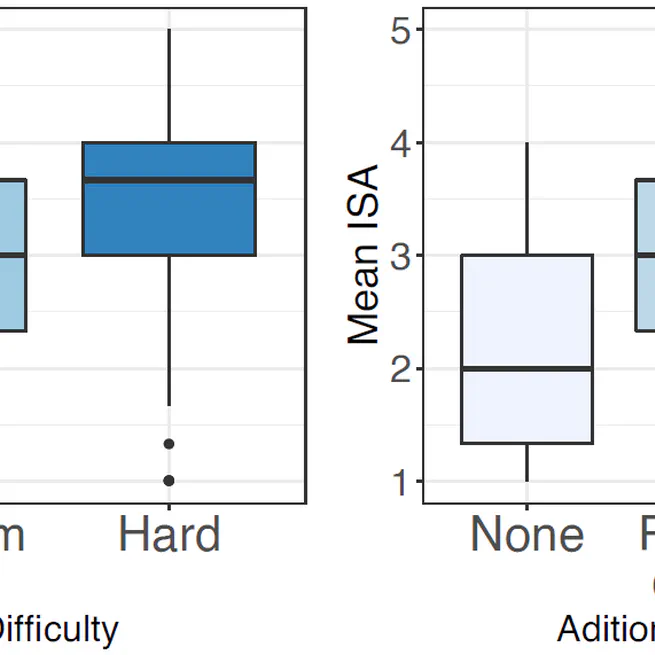
In this paper, we propose to consider Mental Workload (MWL) for the design of complex training scenarios involving multiple parallel tasks in VR. The proposed approach is based on the assessment of the MWL elicited by each potential task configuration in the training application. Following the assessment, the resulting model is then used to create training scenarios able to modulate the user’s MWL over time. This approach is illustrated by a VR flight training simulator based on the Multi-Attribute Task Battery II. Two user studies (Ntot = 52) confirmed that the approach was able to induce the expected mental workload over time.
Mar 6, 2020
Studying the Mental Effort in Virtual Versus Real Environments
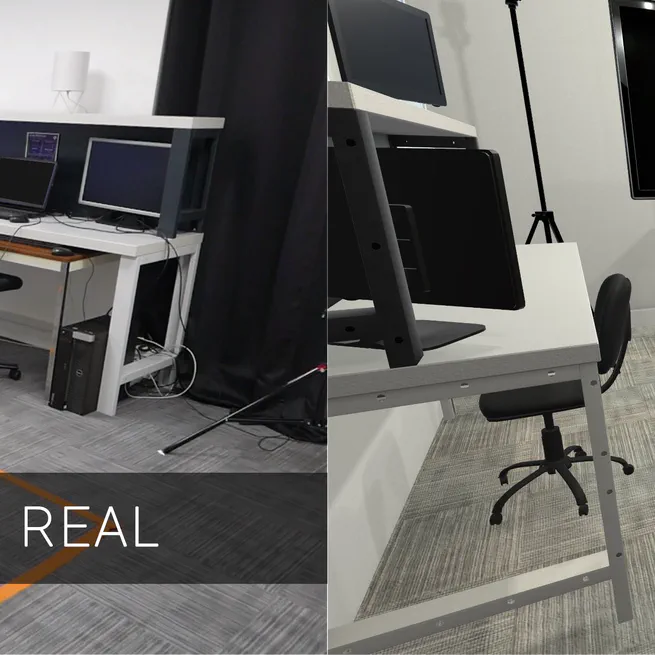
Is there an effect of Virtual Reality Head-Mounted Display on the user's mental effort? In this paper, we compare the mental effort in virtual versus in real environments. An experiment (N = 27) was conducted to assess the effect of being immersed in a virtual environment using an HMD on the user's mental effort while performing a standardized cognitive task (the well-known N-back task, with three levels of difficulty, N ∈ 1,2,3). We also explored the impact of performing a dual task (i.e., sitting versus walking) in both environments on mental effort.
Mar 6, 2019